【Step 1 · Image recognition (qwen3.7-plus)】
Below is the structured analysis for this product image:

1. Category
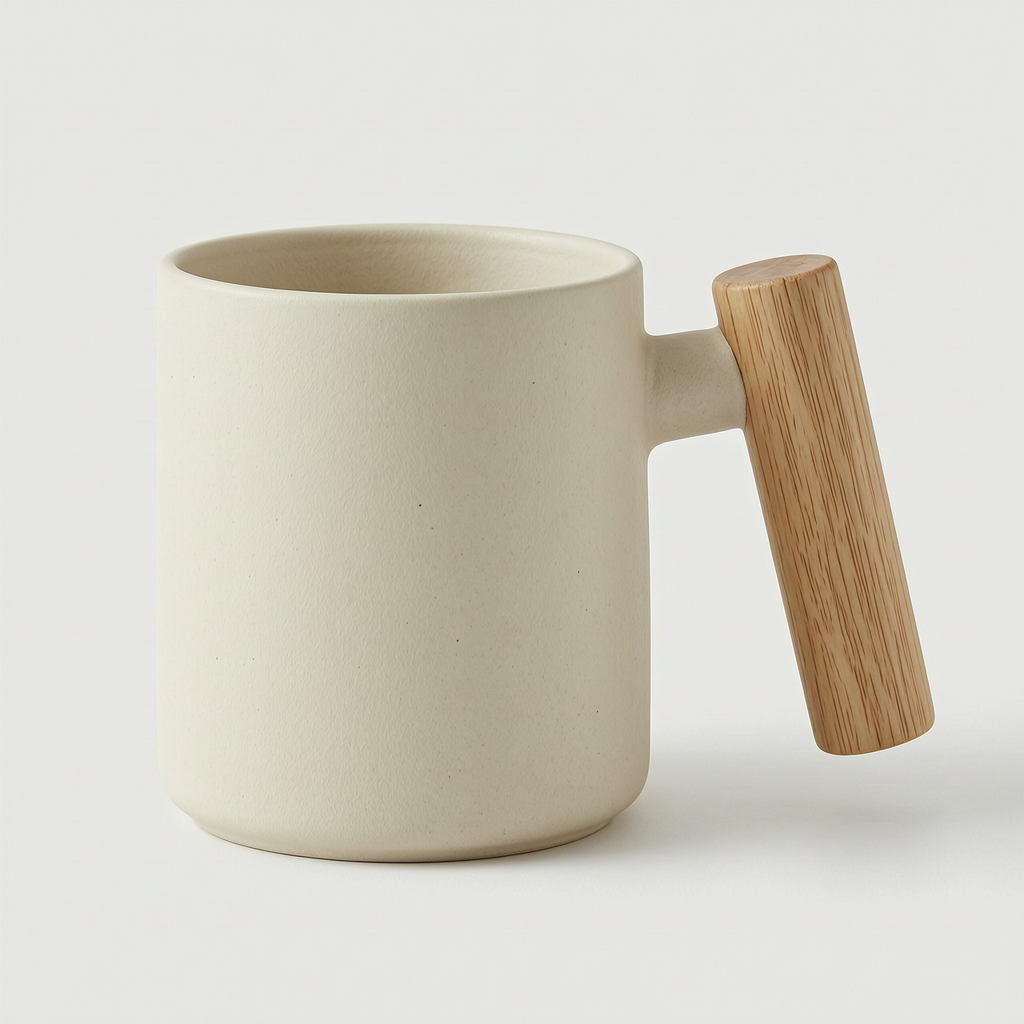
* Mug / coffee cup / drinking cup (cup with handle)

2. Material
* Body: ceramic (appears to be stoneware or coarse pottery, surface is matte off-white / cream glaze, with fine grain).
* Handle: solid wood (clear grain, suspected oak, beech, or ash).

3. Core selling points (3)
* Mixed-material aesthetic: the warmth of ceramic combined with the natural grain of raw wood presents a minimalist Nordic / Japanese style, rich visual layers, highly design-forward.
* Heat-proof and comfortable grip: the wooden long handle has low thermal conductivity, effectively preventing burns; the long-handle design is ergonomic, comfortable to hold, and keeps the hand from touching the cup body.
* Premium matte feel: the body uses a fine matte / frosted finish, non-reflective, looks understated and premium, well suited for everyday photo sharing (Instagram style).

4. Target audience
* Young people who pursue quality of life (white-collar workers, university students).
* Fans of minimalist, Nordic, or Japanese home styles.
* Coffee and tea drinkers.
* Consumers who care about tableware aesthetics and feel.

5. Possible infringement or prohibited-item risk points
* Design patents: this "ceramic body + long wooden handle" distinctive connection design is highly recognizable and can easily infringe on the design patents of well-known home brands (e.g., HAY, Muji, or independent designer brands); verify the source of goods.
* Food-safety compliance: as a food-contact container, the varnish / coating on the wood surface and the ceramic glaze must meet food-safety standards (e.g., lead-free, non-toxic); if the wood is improperly treated it may mold or leach harmful substances.
* Image copyright: this is a high-quality professional still-life studio shot; if directly stolen for an e-commerce detail page, there is a risk of infringing the original photographer's or brand's copyright.

【Step 2 · Pricing reasoning (qwen3.7-plus)】
For your "ceramic + solid wood handle mug" US-site project, below is the detailed profit trial, pricing suggestion, and the list of compliance issues to check before listing.

---

1. Profit trial and pricing suggestion

1. Core cost and assumption breakdown
Before the trial, one key variable must be filled in: the FBA fulfillment fee.
* Product estimate: ceramic body + solid wood handle; estimated single-unit weight 450g-550g, packaged size about 12×10×10 cm.
* FBA fee estimate: falls in the "Large Standard" size tier, weight about 1-1.5 lb. Per 2024 Amazon US-site FBA rates, the estimated per-unit FBA fulfillment fee is about $5.00 (about ¥35.5 RMB). Note: the actual fee is subject to Amazon's measured precise dimensions and weight after inbound.
* Per-unit hard cost (RMB) = purchase (¥18) + first-leg (¥6) + FBA estimate (¥35.5) = ¥59.5

2. Pricing formula derivation
Amazon's commission and advertising fees are calculated on the product price.
* Per-unit total cost (USD) = ¥59.5 ÷ 7.1 = $8.38
* Break-even formula: price × (1 - commission 15% - ad 12%) = per-unit total cost
* Target gross margin formula: price × (1 - commission 15% - ad 12% - target margin 30%) = per-unit total cost

3. Specific price calculation
* Break-even price:
    * $8.38 ÷ (1 - 0.15 - 0.12) = $8.38 ÷ 0.73 = $11.48
    * (i.e., pricing below $11.48 starts losing money)
* Target price (Target Price, meeting 30% margin):
    * $8.38 ÷ (1 - 0.15 - 0.12 - 0.30) = $8.38 ÷ 0.43 = $19.49

4. Suggested price range and strategy
Combined with the market pricing of comparable products on Amazon US (design-forward / solid wood handle ceramic mugs typically run $15-$25), the suggested pricing is:
* Everyday suggested price range: $19.99 - $22.99
    * $19.99: as the main price during the new-product or promotion period, with a gross margin of about 30.4%, just meeting the bar and helping quickly accumulate sales and reviews.
    * $22.99: as the price during the stable period or when listing authority is high, with a gross margin up to 36.5%, leaving more profit room.
* Risk note: if your product packaging becomes so large that the FBA size tier shifts to "Small Oversize," or the weight exceeds 1.5 lb, the FBA fee will rise to $6.5-$7.5, and the target price must be adjusted upward to $21.99 - $24.99 to hold a 30% margin.

---

2. Pre-listing compliance rectification checklist (key)

"Ceramic" + "solid wood" + "food contact" is a major pain point for Amazon compliance review; before listing, complete the following rectification and certification:

1. Food-contact safety compliance (for the ceramic body)
* FDA food-contact testing: the ceramic glaze must pass US FDA testing, especially for lead and cadmium leaching (meeting FDA CPG 7117.06/07). A third-party lab with ISO 17025 qualifications (e.g., SGS, TUV, ITS) must issue the test report.
* California Proposition 65: California is very strict on lead / cadmium / phthalates and other harmful substances. The ceramic glaze and solid wood handle may both trigger Prop 65.
    * Rectification: either pass testing to prove no exceedance; or affix the standard Prop 65 warning label on the product packaging and listing (to avoid being sued for damages by professional counterfeit-product claimants).

2. Wood import and environmental compliance (for the solid wood handle)
* Lacey Act declaration: the US Department of Agriculture (USDA) requires all imported plant products to be declared.
    * Rectification: provide a PPQ 505 form at shipment, accurately declaring the wood's Latin scientific name (e.g., beech Fagus sylvatica), country of origin, etc., proving it is not an endangered species.
* APHIS pest and mold inspection: solid wood is highly likely to carry insect eggs or mold, with a high customs inspection rate.
    * Rectification: ensure the wood undergoes strict drying, fumigation, or anti-mold treatment. Place desiccant inside the packaging and affix a "pest/mold treatment done" mark on the outer carton.
* EPA TSCA Title VI (formaldehyde release): if the solid wood handle is not whole wood but joined wood, or has a surface coating / varnish, it must meet the US EPA formaldehyde release standard. Pure whole cut solid wood may be exempt but should be kept on file for inspection.

3. Packaging and labeling compliance
* Suffocation warning: if the product uses plastic bag packaging and the bag's flat opening exceeds 5 inches, a suffocation warning must be printed on the bag (mandatory in several US states such as California, New York, Massachusetts).
* Country of origin marking: on the product body (bottom of the cup) or the minimum sales packaging, there must be a clear "Made in China" or "Product of China" mark, otherwise customs may hold the shipment.
* Children's product delineation (CPC risk):
    * Rectification: if the cup's pattern or shape is cartoon, animal, or fairy-tale style, Amazon's system may misjudge it as a "product for children under 12," requiring CPC certification and CPSC lab testing. Adult mugs are recommended to use minimalist, ins-style, solid color, or geometric patterns, and to clearly mark on the listing "Not intended for children under 12 years of age."

4. Intellectual property check
* Design patents: the shape of the solid wood handle, the special texture of the body, or the overall form must be checked at the US Patent and Trademark Office (USPTO) for similar design patents.
* Trademarks and patterns: the cup's printed pattern and logo must not carry unauthorized brand names, well-known IPs (e.g., Disney, Marvel, Starbucks), or copyrighted illustrations.

---

3. Additional operational advice for sellers

1. Packaging drop-test design (determines return rate): ceramic + solid wood handle is fragile and has an unstable center of gravity. The drop test (ISTA 3A) must pass. It is recommended to use "custom EPE foam slots + corrugated outer carton," ensuring the handle is suspended and bears no force. Once broken, you lose not only the payment but the listing may be taken down.
2. Avoid the "oversize" trap: to save on FBA fees, optimize the packaging size. If the length including the handle exceeds 15 inches, or the weight exceeds 20 lb, it falls into the "Oversize" tier and the FBA fee doubles, eating all profit.
3. Selling-point differentiation: the pain points of solid wood handles are "easy to crack" and "cannot go in the microwave / dishwasher." In the listing's A+ page and main-image video, clearly explain the wood treatment process (e.g., food-grade beeswax oil coating, anti-crack treatment), and clearly mark whether the microwave and dishwasher are supported, to reduce complaints and negative reviews.