

Upload a promo image, Qwen3.8-flash vision extracts product, price, coupon and rule fields into fixed JSON, and screens copy for pre-launch risks.
Turn a promo image into fixed-field JSON while screening copy for pre-launch risks.
This walkthrough uses an 800×2262 vertical pre-sale image (4 products, strikethrough/promo/deposit prices, 3 coupons, fine-print rules): everything in a marketing image—products, prices, coupons, rules—is image, can't go into a table or be searched, and copy must be vetted sentence by sentence before launch. Ask qwen3.8-flash to output fixed-field JSON in one pass—product fields, coupon info, risk findings (tiered + rewrite suggestions), internal contradictions, false-positive self-check, info to confirm. The image has 8 test points, one a decoy for false positives.
Call chain: qwen3.8-flash (promo image base64 input → product fields + coupons + risk findings + contradiction list). Vision understanding + structured output.
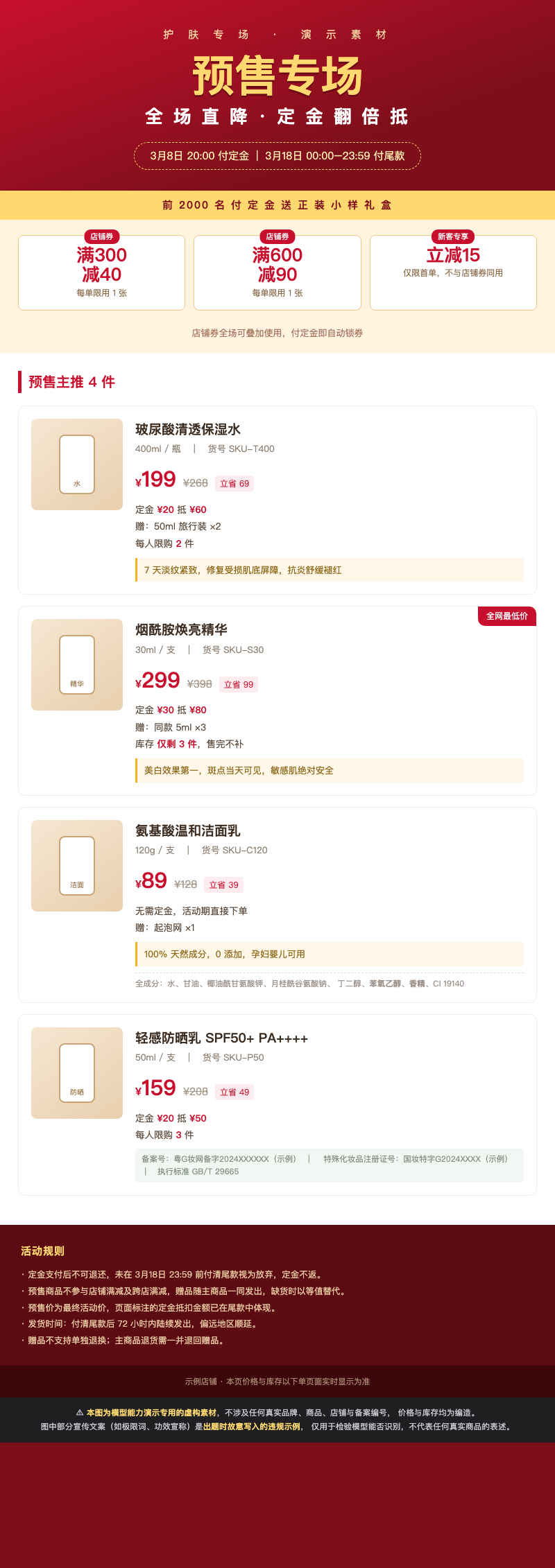 Example input · full promo image fed to the model (800×2262, fictional demo material, no real brands, shops, or registration numbers)
Send the image along with the prompt below to qwen3.8-flash. For batch field extraction, thinking off is sufficient—fast and field accuracy is stable:
Key parameters:
Under OpenAI-compatible mode,
Disclaimer: All content on this page is AI-generated, for reference only, and does not constitute any performance guarantee. Actual results and Credits consumption are subject to the console "Usage Details".
Example input
Steps: upload image and lock output fields
Send the image along with the prompt below to qwen3.8-flash. For batch field extraction, thinking off is sufficient—fast and field accuracy is stable:
enable_thinking goes at the top level of the request body; flash defaults to thinking on.
Notes
- Consumption: This playbook uses vision understanding + text generation (qwen3.8-flash). Image_tokens converted from the long image count toward input; longer/clearer images mean higher input cost. Thinking on: output ~3.6× thinking-off, the extra being reasoning chain.
- Measured result · field extraction (stable): Thinking-off read the full image; 4 products × 10 fields = 40 items all matched the image verbatim (including error-prone item codes). 8 pieces of info not on the image were not fabricated—returned null or empty array. 3 coupons' threshold/discount/restriction all correct. An independent reproduction also got all fields right.
- Measured result · risk screening (unstable): This round thinking-off hit 5 of 8 test points—two absolute-claims rated high, "100% natural ingredients" cross-checked against actual ingredient list flagged as contradiction, decoy not false-positived. Missed three: the implied medical-claim line, the "lowest price network-wide" corner mark, and coupon "stackable storewide" vs rules "pre-sale excluded from discounts" conflict. Same image with thinking-on hit all 8.
- Note: The thinking off/on difference above could not be reproduced—an independent reproduction with the same prompt and material got thinking-off hitting all 8 and thinking-on only 6, the opposite direction. Risk hit rate varies more between individual runs than between the two modes; this page's comparison is a single sample. Before deciding parameter config based on this, run several rounds and look at the distribution.
- Note: Thinking-on reported 7 risks (vs 4 for thinking-off), including flagging the decoy (on review, its reasoning was sound, so not counted as a false positive). It leans "report more rather than miss"—when integrating into automation, review against your own standards.
- Note: Batch field extraction with thinking off is sufficient. Copy risk screening is a pre-launch initial screen only; it does not replace human and legal review. Model risk judgments and statutory citations are reference opinions; verify independently; does not constitute legal advice.
- Material statement: The image in this example is a fictional material made specifically for capability demonstration (HTML rendered then screenshotted). No real brands, products, shops, or registration numbers are involved. Prices and stock are fabricated. Some promotional copy was intentionally written to test the model's recognition ability.